
Botany
24th June-18th September 2026
The first group exhibition at BRINK, Botany brings together the work of six contemporary artists whose practices frame flowers as agents of memory, resistance, and material experimentation. Across painting, printmaking, pigment-making, and textile processes, the exhibition reconsiders the floral image as a site where histories, ecologies, and acts of perception coincide.
Michele Fletcher’s (b. 1963) paintings explore growth, transformation, and material instability through fluid, process-driven methods. Developed wet-into-wet within a single sustained duration, her works generate seamless yet unstable forms that hover between the organic and the synthetic.
For Rashmimala (b. 1975), the flower becomes a means of interrogating the legacy of colonial botanical illustration. Drawing inspiration from the overlooked flora that populate roadsides, walls, and neglected corners, her work shifts attention away from the exoticised specimens traditionally celebrated within colonial archives. Her silk sheets, dyed with natural pigments, mimic the aesthetic language of scientific illustration while simultaneously undoing its authority.
Movement and immediacy characterise the work of Heather Rubinstein (b. 1975), whose gestural abstractions transform floral imagery into surging fields of colour and energy. Her canvases resist stillness entirely: paint drips, spills, and crashes across the surface as though flowers are caught mid-storm or scattered by wind.
Materiality is equally central to the practice of Tanya Goel (b. 1985), whose paintings dissect colour and shape into elemental components before reconstructing them into intricate visual systems. Goel produces her own pigments from charcoal, mica, soil, concrete, aluminium, glass, and architectural debris gathered around New Delhi, thereby embedding urban histories directly into the surface of her work.
Themes of transformation and impermanence emerge in the work of Juliana Dos Santos (b. 1987), who uses the vivid blue pigment of the Tender Clitoria flower as both medium and subject. Painting on cotton fabric, Dos Santos embraces the instability of natural pigment, allowing oxidation to gradually alter the work over the course of the exhibition.
Born in Hong Kong, Halley Cheng’s (b. 1986) practice has often engaged directly with cultural monuments, shared memories and social cohesion. Widely recognized for his irreverent style that seamlessly blends classical Chinese painting traditions with modern imagery, his latest works place a greater emphasis on organic motifs, in which flora is an adaptable metaphor for reinvention and human interaction.
For Kate Bickmore (b. 1993), flowers possess appetite, agency, and power. Widely celebrated for her immersive, large-scale, hyperrealistic oil paintings of flowers, her works reject anthropocentric interpretations of plant life, instead imagining flowers as breathing organisms with their own strange desires and forms of resilience.
Together, these artists expand the language of floral representation beyond ornament or symbolism. Their works ask what it means to look closely at flowers in an age shaped by ecological uncertainty, colonial histories, and material transformation. Across diverse practices, flowers emerge not merely as subjects to be depicted, but as collaborators in processes of decay, growth, memory, and renewal.
For the price list see here.
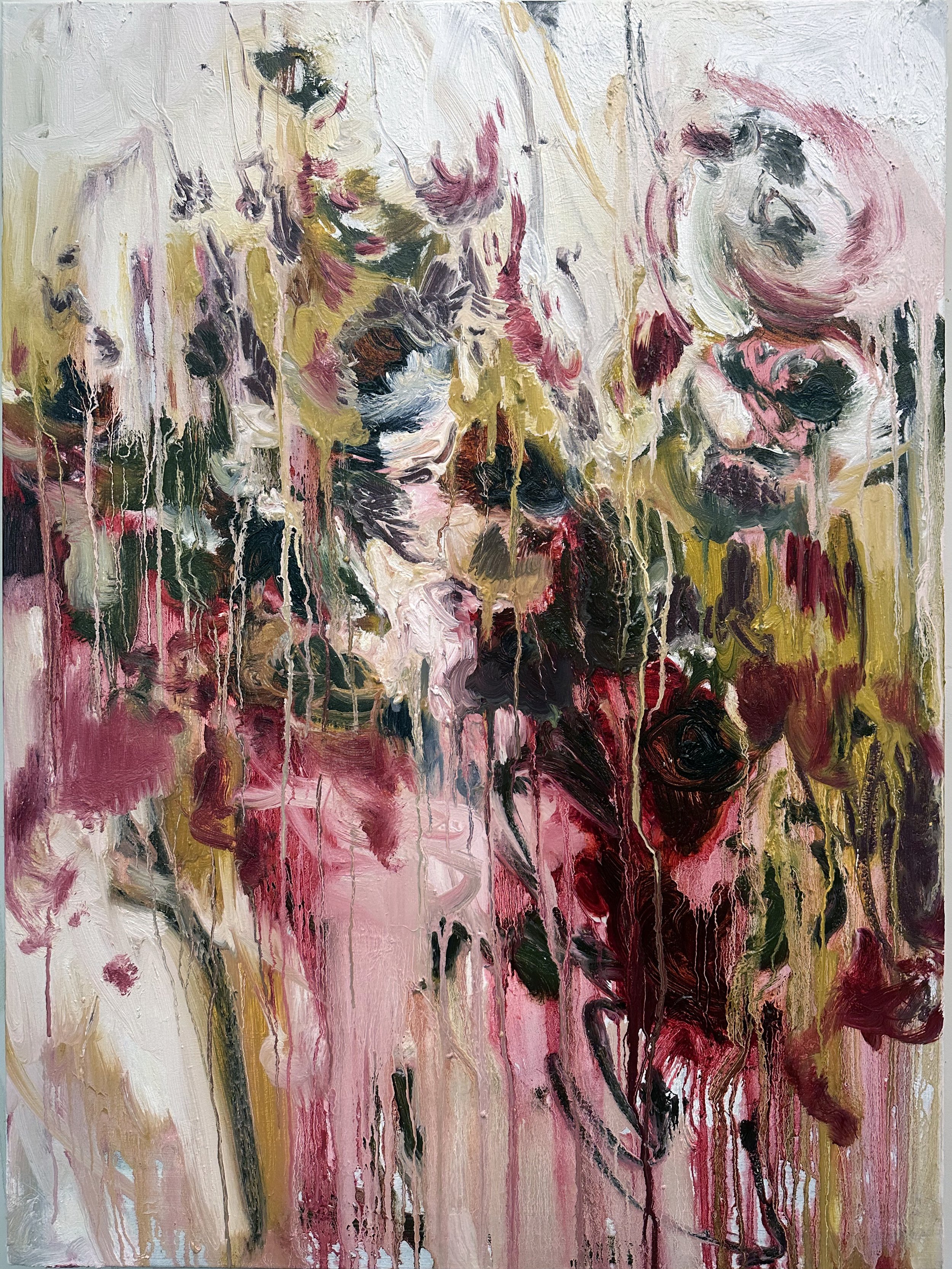
Heather Rubinstein, field study