
Analysis: two drawing of Stonehenge by Philip Hughes
F Heffer
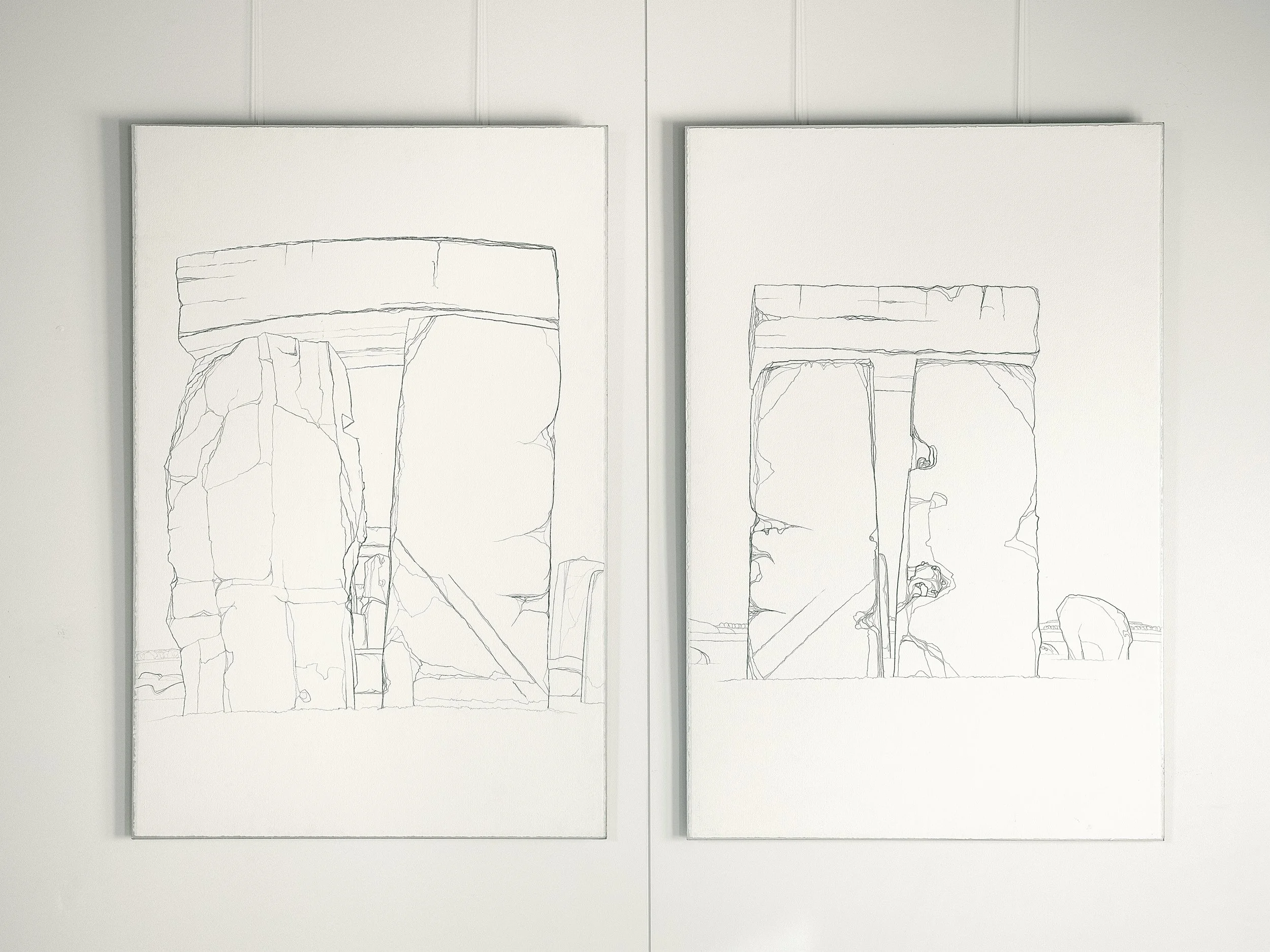
Stonehenge: outer face of Stones 53, 54 & 154, 1998, pencil on paper
Stonehenge: inner face of Stones 53, 54 & 154, 1998, pencil on paper
The line describes the form with clarity and precision.
The representation of stone through line alone is an abstract one. There are no lines in nature. The line in Philip’s drawings delineates a non-space, where absence meets presence. In the landscape, standing before these lintel stones, line does not exist, only the moment where stone meets sky. A question arises: does Philip’s line keep the stone in or the sky out?
This exhibition at BRINK, entitled Callanish to Chysauster, is well placed to ask questions such as these. This is the first ever exhibition of Philip’s drawings, and the absence of paint means that the line must step up to the mark and describe a form that is massive, weights over thirty tonnes, is opaque, smooth and covered in lichen. The line must describe not only the stones themselves, but the relationship between stones, between the ground and the stones and between the sky and the stones.
Without the aid of colour, line alone must give form, heft and history. Philip discards even shade, his faith in the single line undiminished. This confidence is hard won.
The artist reveres these mute, inexplicable stones. His reverence means that he does not pander to his audience. He does not dumb the stones down with black skies and rainbows. There are no Gods in Philip’s work. He has killed them off. Instead, there is the power of observation, evidenced by masterful draughtsmanship. The stones are put onto the paper, their mystery intact.
And so, the drawings compel one to visit them and be among them.
And when you arrive at Stonehenge and a druidy druid asks why you came, say Philip Hughes sent me, I am here at the behest of his drawings. I came to see what he saw.